
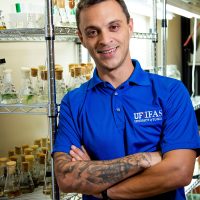
H. Dail Laughinghouse IV
University of Florida, Institute of Food and Agricultural Sciences (UF/IFAS), Laughinghouse Phycology Lab
Title: From Salty to Sweet: Our Blue Green Friends Along the Continuum
Bio Sketch
H. Dail Laughinghouse IV is an Associate Professor of Applied Phycology in the Agronomy Department at the University of Florida, (UF/IFAS), leading the Laughinghouse Phycology Lab. Dail is a broadly trained phycologist whose research spans both basic and applied algal science from tropical to polar environments. His work focuses on algal biodiversity and systematics, harmful algal blooms (HABs), cyanobacterial toxins, microbial photoautotrophs, bioremediation, biofuels, metagenomics, and metatranscriptomics. His research integrates ecology, molecular biology, genetics, chemistry, and environmental science to better understand algal communities and develop practical applications for environmental management and sustainability.
Current projects in his laboratory include inventorying aquatic algae in Florida and beyond, investigating environmental triggers of algal blooms, developing algae control and mitigation strategies, and conducting genomic studies of algae and algal toxins. In addition to his research program, Dr. Laughinghouse is deeply engaged in teaching, extension, and public outreach.
He provides statewide leadership on algal issues in Florida, working closely with county and regional extension agents on water quality, algal identification, monitoring, and management. Through initiatives such as the Volunteer Algae Monitoring Program (VAMP), he promotes science-based approaches to understanding and managing algal communities in aquatic environments.
His academic and teaching experience includes serving as a Lecturer in Arctic Marine Molecular Ecology, Arctic Microbiology, Arctic Ecology, and Terrestrial Arctic Biology at the University Centre in Svalbard (Norway); a Teaching Assistant in Algology at the University of Liège (Belgium); and a Teaching Assistant in Genetics at the University of Maryland, College Park (USA).
Current projects in his laboratory include inventorying aquatic algae in Florida and beyond, investigating environmental triggers of algal blooms, developing algae control and mitigation strategies, and conducting genomic studies of algae and algal toxins. In addition to his research program, Dr. Laughinghouse is deeply engaged in teaching, extension, and public outreach.
He provides statewide leadership on algal issues in Florida, working closely with county and regional extension agents on water quality, algal identification, monitoring, and management. Through initiatives such as the Volunteer Algae Monitoring Program (VAMP), he promotes science-based approaches to understanding and managing algal communities in aquatic environments.
His academic and teaching experience includes serving as a Lecturer in Arctic Marine Molecular Ecology, Arctic Microbiology, Arctic Ecology, and Terrestrial Arctic Biology at the University Centre in Svalbard (Norway); a Teaching Assistant in Algology at the University of Liège (Belgium); and a Teaching Assistant in Genetics at the University of Maryland, College Park (USA).
Abstract
Cyanobacteria, commonly known as blue-green algae, are found across marine, estuarine, freshwater, and terrestrial environments, where they play essential roles in ecosystem functioning and water quality. This presentation explores their diversity and ecological significance along the continuum from salty to freshwater systems. Drawing on research in algal ecology, molecular biology, genomics, and harmful algal blooms, Dr. Laughinghouse will discuss the factors that influence cyanobacterial distribution, bloom formation, and toxin production. The talk will also highlight how modern genomic tools are advancing our understanding of these organisms. Beyond their environmental challenges, cyanobacteria and other algae offer valuable opportunities for bioremediation, sustainable biotechnology, and ecosystem management, providing insights into both their risks and benefits across interconnected aquatic environments.